2.2 CA Certificate & Network Time Protocol (NTP)
This article provides information about Certificate Authority (CA) certificate installation and network time server configuration.
Certificate Authority (CA) certificate installation
Service Provider applications running on a CollabOS device use Certificate Authority certificates installed in CollabOS to securely validate network connections to the Service Provider's cloud services and other remote servers.
If your network includes a firewall, web proxy or similar network service that performs "TLS inspection" (also known as "SSL inspection," "HTTPS inspection," "deep packet inspection" or similar), you may need to upload a Certificate Authority certificate to your CollabOS device to allow Service Provider applications to function, or exempt the Service Provider application's network traffic from inspection in your firewall, web proxy or similar network service. Consult your Service Provider's documentation to learn more about support for TLS inspection.
Similarly, if a Service Provider application running on a CollabOS device will connect to remote servers on your enterprise network that are secured by a TLS certificate issued by an enterprise PKI solution or certificate authority, you may need to upload a Certificate Authority certificate to your CollabOS device to allow these connections to succeed. Consult your server or Enterprise PKI administrator to learn if a CA certificate is needed to ensure fully validated network connections.
Notes:
Certificate Authority certificate installation can only be performed via Local Network Access (LNA)
Supported certificate file types: .pem (base64 text format, commonly also uses filename extensions .crt or .cer), and .der (binary format).
Maximum supported file size: 15KB
CollabOS 1.8 release added support for multiple certificates. You can now upload up to 50 CA certificates to your device.
The Microsoft Teams Rooms on Android and Microsoft Teams Panels Service Provider applications do not support the use of uploaded CA certificates for web proxy or firewall SSL inspection. See Proxy servers for Microsoft Teams and Skype for Business, section "If you need to use a proxy server," where it is stated "Installing privately signed certificates on Teams Phones and other Android-based Teams devices is not supported."
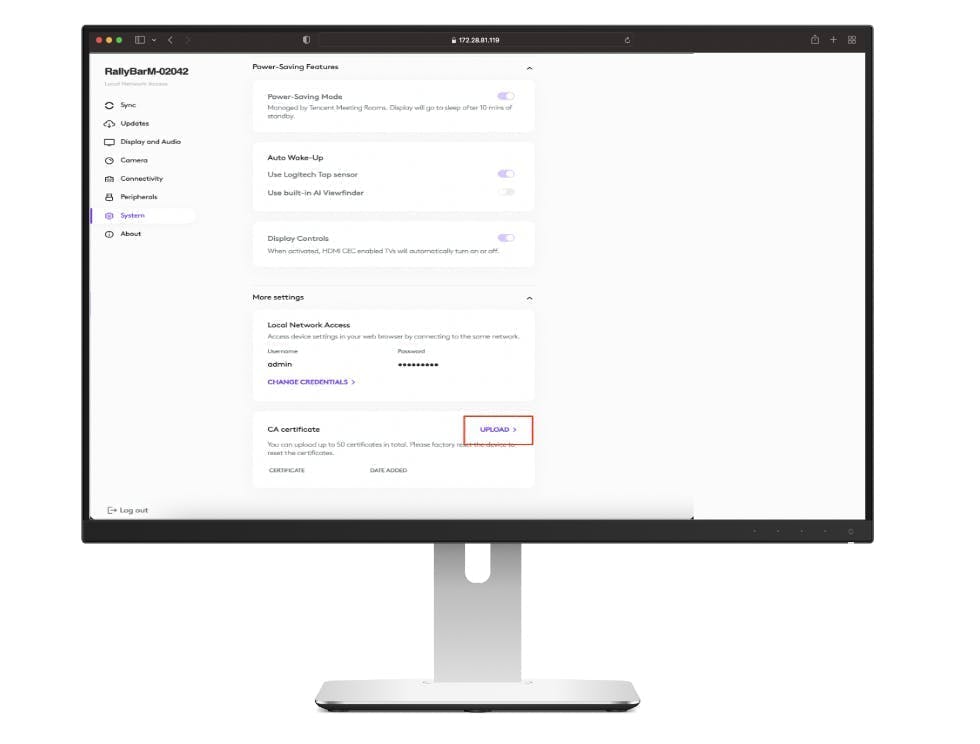
Upload a CA certificate
Login to your Local Network Access.
Select System.
Scroll down and select "More Settings."
Scroll down to the CA certificate and click the Upload icon to configure the CA certificate.
Click Upload and select the CA certificate file and click OK.
Network Time Protocol (NTP)
CollabOS supports two methods of network time server configuration:
Automatic: based on the selected time zone, the device uses time.android.com for time synchronization.
Manual: enter the NTP server address manually.
NTP On-Device
During New Device Setup:
1. In the setup interface, select Wired/Wireless Network Setup on the network connection screen.

2. Scroll down to System Settings
If Auto-configure time server is enabled, the time will be set to the time zone selected in regional settings.
3. To set the NTP Server, disable Auto-configuration and add Time server address.

4. Type in the NTP server address and select Next to continue the device setup.
Add to Existing Device:
1. Open the Device Settings.
2. Select System.

3. Tap Regional Settings.

If Auto-configuration is enabled, the time will be set to the time zone selected in regional settings.

4. To set the NTP Server, disable "Auto-configuration" and tap NTP Server.

5. Type in the NTP server address and select Done to confirm.

NTP on Local Network Access
During New Device Setup:
1. In the Local Network Access setup interface, select Network Connection > System Settings > Internet. Time.

If Auto-configuration is enabled, the time will be set to the time zone selected in regional settings.
2. To set the NTP Server, disable "Auto-configuration" and add NTP Server.
3. Type in the NTP server address and click Continue.

Add to Existing Device:
1. Activate and login to Local Network Access.
2. Select System.

3. Scroll down and select Regional Settings.
4. Scroll down to "Internet Time."

If Auto-configuration is enabled, the time will be set to the time zone selected in regional settings.
5. To set the NTP Server, disable "Auto-configuration" and add NTP Server.

6. Type in the NTP server address and select Apply to confirm.

If you are facing a device specific issue, we recommend opening a ticket with Prosupport.